
“What makes extraordinary teaming possible — especially when everything is changing
”
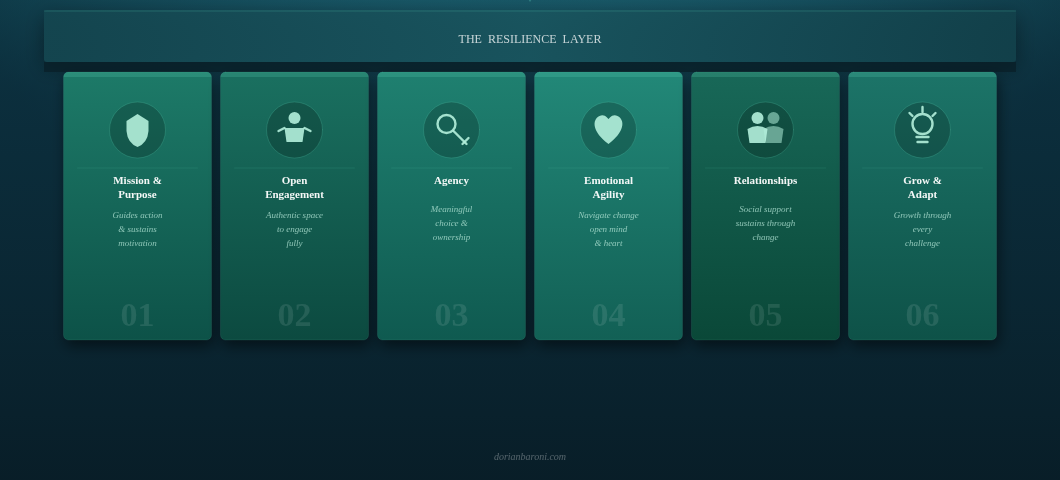
The question beneath the question
When organizations come to me asking how to build high-performing, high-humanity teams during periods of major strategic change, there is always a second question hiding underneath the first one.
It isn't just how do we team better?
It's: how do we sustain the quality of our teaming when the pressure is relentless, the direction keeps shifting, and people are running out of runway?
That second question points to something most transformation frameworks miss entirely. Before you can grow an extraordinary team, something else has to be in place. A layer beneath the teaming. A set of conditions — organizational, cultural, relational, and personal — that either quietly enable everything your team is trying to build, or gradually erode it from the ground up.
I call this The Resilience Layer (™).
Resilience is not a personality trait
There is a persistent and damaging myth that resilience is something people either have or don't have — a kind of grit, a thickness of skin, a capacity to absorb punishment without complaint.
That framing puts the burden entirely on the individual and absolves organizations of any responsibility for the conditions they create.
I see it differently.
Resilience — the kind that allows individuals and teams to genuinely thrive during strategic transformation, not merely survive it — is not a fixed trait. It is a set of conditions that can be deliberately, thoughtfully cultivated. Conditions that leaders and organizations have far more influence over than they typically realize.
When these conditions are present, teams can absorb disruption, adapt without losing cohesion, and keep showing up with creativity and commitment even as the landscape shifts beneath them.
When they are absent, even the most talented, well-intentioned teams eventually fracture — not because the people weren't good enough, but because the environment didn't hold them.
The 6 Conditions of Resilience
Through my work with leaders and teams navigating complex, high-stakes transformations, I have identified six conditions that consistently differentiate organizations that thrive through change from those that merely endure it.
Mission & Purpose
Guides action and sustains motivation
A compelling, clearly articulated purpose is not a communications exercise. It is an anchor. When structures shift, roles change, and familiar routines disappear, the why is what keeps people oriented and motivated. Purpose must be revisited and re-communicated not just at launch, but at every milestone, every setback, every inflection point. It is the one thing that should not change when everything else does
Open Engagement
Creates the environment where people can engage authentically
Resilience flourishes where people feel genuinely safe to speak up, ask questions, express uncertainty, and bring their full perspective — even when that perspective is uncomfortable. Open engagement is not about niceness or harmony. It is about creating the conditions for authentic participation rather than performative compliance. In a transformation, that distinction is the difference between people who are truly committed and people who are merely going through the motions.
Agency
Enables meaningful choice and ownership over how work happens
People endure and adapt to change far better when they retain meaningful control over some aspect of how their work happens. Even within tightly constrained transformation environments, providing genuine choice — over timing, methods, priorities, or ways of working — activates a sense of ownership that dramatically reduces resistance. Agency is not about autonomy for its own sake. It is the precondition for real commitment.
Emotional Agility
Allows navigating change with an open mind and heart
Strategic transformation generates a full spectrum of emotion — excitement, grief, frustration, confusion, hope. Emotionally agile individuals and cultures have the capacity to process these experiences honestly rather than suppress them, which enables faster recovery, better decision-making, and more generous responses to the inevitable friction of change. This is not soft. It is one of the most practically consequential capacities a team can develop.
Relationships
Builds the social support that sustains through ups and downs
The quality of human connection within a team or organisation is its single greatest buffer against the isolation and fatigue that long transformations generate. Strong relationships — peer-to-peer, cross-functional, between leaders and their teams — don't just make work more enjoyable. They carry people through the moments when individual reserves run dry. Investing in relationship health during transformation is not a luxury. It is a strategic necessity.
Grow & Adapt
Provides opportunities for development and growth
Organizations that treat transformation as a learning journey rather than a fixed execution plan develop a lasting adaptive capacity that outlives any single change initiative. Creating structured space to experiment, reflect, and incorporate new insights keeps momentum alive, prevents rigidity, and — critically — signals to people that their development matters, not just their performance. A culture that grows and adapts is a resilience culture.
The relationship to Extraordinary Teaming
These six conditions are the soil in which Extraordinary Teaming takes root and grows.
The Extraordinary Teaming framework describes the conditions needed for the how teams function at their best. The Resilience Layer describes the hidden strengths that make it possible to sustain that quality of teaming when a strategic transformation is putting everything under pressure.
Without the Resilience Layer, even the best intentioned teaming efforts will eventually be overtaken by change fatigue, disconnection, or a loss of purpose. Without the extraordinary teaming conditions and capacities, resilience stays individual and fragile — people enduring in isolation rather than growing together.
The two frameworks are designed to work in tandem. For teams navigating transformation, I recommend working with both.
Working with these strengths
I work with leaders and teams to assess where these dimensions are strong, where they are absent, and — most importantly — what it would take to cultivate them deliberately within your specific context.
This work takes several forms: leadership coaching, team consulting, facilitated workshops, and longer-term transformation support. Every engagement begins with an honest conversation about where you are and what you are genuinely trying to build.
If you are leading a team or an organization through significant change and you sense that something beneath the surface is making it harder than it should be, I would be glad to think through it with you.
Email me at dorian@dorianbaroni.com